Sunday, August 14, 2016

Winning at Flight-Delay Roulette

Last Thursday, I took a last-minute flight to Alabama to be with a loved one who was going to be having urgent surgery Friday morning. My plane out of Seattle was delayed by over an hour, which meant my tight connection in Dallas was a lost cause. By the time my flight was starting its final descent into Dallas, the plane I was supposed to catch to Huntsville was listed as already departed 15 minutes ago.

Aiming for a back-up option, I hustled off my plane when it landed, sprinted through the airport from A6 to C38.
A map of the Dallas-Fort Worth Airport terminals. 
Ever notice how despite their adjacent position in the alphabet,
Terminal B and Terminal C are about as far apart
 on the rail link line as they could possibly be?
Every time I've been in this airport, there's a steady stream
 of people running the frantic B-to-C marathon
with a blend of hope, desperation, and resignation
 in their eyes, leaving a trail of mini pretzels and
foil-packed peanuts in their wake.
Then, (gasping for breath) at C38 I tried to implore a gate agent to switch me onto a flight to Nashville. I figured with a little luck I could arrive to Tennessee at Oh-dark-hundred, rent a car, and drive down to Alabama in time to reach the hospital by morning.
But then a strange thing happened:  The gate agent said the Huntsville flight was listed wrong, and that it hadn't even boarded yet!

I sprinted back through the airport.
Also, ever noticed that the rather curvaceous
 Dallas-Fort Worth Airport layout was
probably designed based on Mr Peanut's dream girl?

Then, (gasping for breath), reached Gate B26 just in time for my originally-intended flight. The other 49 passengers at the gate were disgruntled, impatient, and frustrated that they had been standing around waiting on a delayed plane for nearly two hours.  Meanwhile, I was sweaty, disheveled, and smiling from ear to ear. I've never been so grateful for a delayed flight in my whole life.
Somehow, it felt like the cosmic wheel of airport chance had finally spun in my favor, with a 'near make' instead of a 'near miss' this time.

Although, having given it further thought,
maybe I should give up the gamble and
start traveling by Mr Peanut Hot Air Balloon
rather than by plane from now on.
 

Saturday, July 9, 2016

The Dictation SpoonPen

Every Wednesday, I work in a surgery center on the east side of the city with a private practice doctor. In order stay on time we keep a pretty tight schedule, operating as efficiently as possible and then packing hundreds of other tasks (signing forms, returning calls, reviewing labs and imaging and pathology reports, dictating notes, sending prescriptions) into the few minutes between cases while the room staff sets up for the next surgery. Relentless multitasking is the only way to survive. There's an unspoken policy of don't-eat-don't-stop-don't-use-the-bathroom-just-plough-onward.
 
Last week between cases, I hustled into the workroom to grab some paperwork and finalize an operative report, and there on the desk I encountered this thing:
 

It's a pen and a spoon joined together by tape and labeled with the word "Dictation."
What does it mean? What is it for?
Is it a sad little sculpture, imploring us to remember to eat? An ironic acknowledgement that we're skipping breakfast and/or lunch and/or dinner because there are notes to dictate and paperwork to do instead? Is it a multitasking tool enabling us to sign charts -AND- stir beverages at the same time?

Realistically, it's probably just someone's attempt to keep the pens in the dictation room from getting accidentally pocketed or lost. But for a moment when I saw it on the desk, it seemed like the very essence of what it means to be a tired-busy-overbooked surgeon with a full bladder, an empty stomach, and an endless mountain of work to do.
So here's to the SpoonPen! Symbol of my life.
 

Saturday, July 2, 2016

Saturday, June 18, 2016

Close encounters of the Aircraft kind

Here's something you don't see every day:

On my recent flight to San Francisco, I looked out the window and saw another plane heading in to land at the same airport.

At about the same altitude as ours.

Flying about the same speed as ours.

Converging to the same landing pattern as ours.
Coming ever closer. Close enough that we could read the logo on the plane.

Close enough that we could see the people peeking out from their windows to look at us while we looked back at them.

Fortunately, our pilot had already explained that this is a totally normal air traffic pattern for San Francisco International.
So, from the flight landing on Runway 28 Left, say an uncomfortably close "Hello" to the flight landing on Runway 28 Right!
 

Thursday, June 9, 2016

Empathy is a bad thing?

A Yale professor released this video as a teaser for his new book about empathy. The main thesis is that empathy -- our urge to help our fellow human beings because we put ourselves in their shoes and want to ease their burden -- is a morally bad thing that makes the world worse.

http://www.theatlantic.com/video/index/474588/why-empathy-is-a-bad-thing/

For example, if you have $100 to donate to charity
 - donating $1 each to a hundred different organizations makes you feel good a hundred times. Mathematically speaking, Feel Good x 100 = Feel Amazing!  However, that $1 costs more to process than it's worth, so the charity itself might actually lose money as a result of your generosity. 
 - donating $100 to a single organization only makes you feel good once. If you're keeping track, that's a whole lot less warm glow for your money, as Feel Good x 1 = Feel Good.  However, the recipient charity gets a useful amount from your donation, so it's a much better allocation of your cash even though it doesn't necessarily feel that way to you.

In his other examples, our empathy tends to get directed toward specific individuals more than toward larger more abstract causes. 
 - "We care more about a single baby stuck in a well than we do about global warming."
 - Governments use specific examples of suffering victims to motivate their country to go to war, but then the war causes orders of magnitude more suffering than the problems that incited it.

Is he right?
Does caring about other people and trying to help them really make the world worse?

Personally, I think he's deliberately graying the line between (A) empathy, versus (B) selfish motives disguised as empathy, and (C) empathetic people who get channeled unwittingly into being the engine behind a non-empathetic action.

True, empathy makes us vulnerable. There are plenty of times when I feel someone's pain and really wish I didn't feel it.

True, for some people the reason for helping others isn't that it relieves human suffering but rather that it feels so dang good to brag about it later.  (I'm talking about you, International Volunteer who mainly did the trip in order to get selfies with orphans to post on Facebook.)

True, one person's authentic urge to help can get harnessed by another person's calculated desire for power. (I'm talking about you, Activist Protester who's sincerely in it to help the poor union workers in the American Rust Belt, but ultimately just ends up as part of a faceless mass of voters trying to bring someone like Donald Trump to power, when Trump himself is probably one of the last people on earth who'd actually care what it's like to be poor or what life is like in a blue collar job.)

But despite all of that, real empathy is a moral must-have for a society. In and of itself, it cannot possibly make the world worse. The alternative is insensitivity, intolerance, or even sociopathy.
What if we stopped wanting to comfort a crying baby?
What if we felt nothing at all in the face of 300,000 displaced Syrian refugees trying to cross the Mediterranean as their last desperate effort for survival?
What if everyone just kept walking when an old woman stumbled and fell into the street while trying to step down off the city bus?
What if it didn't matter when your brother, son, father, or friend got diagnosed with terminal cancer?

True, we could be more thoughtful about the causes that we apply our altruism toward, and we should critically evaluate our real motives, but it would likely be the death of humanity as we know it if we stopped feeling the urge to help others altogether.

Tuesday, May 17, 2016

Outside the natural habitat

Every year, the Seattle Symphony does a concert featuring the music of independent local composers. The artists are there in the audience to come up on stage and discuss the piece before it's performed. I went into this one with my eyes wide open, knowing that "indie" probably means "modern," and "modern" virtually always means "weird," and "weird" directly translates as "immensely talented but painful to listen to."

The evening was rather hard to describe.
There was a black-and-white silent film about shipwrecks, vaguely-implied infidelity, and the dangers of sleeping on rocky beaches at high tide, which played on screen while a woman in a bright orange dress pounded the 5 lowest keys on a grand piano for 21 solid minutes.
One of the pieces featured cowbells.
And toward the end of a program, a local rapper performed the drum solo from a Phil Collins song, backed by a 60-piece orchestra full of musical prodigies wondering how their Juilliard training had culminated in something like this.

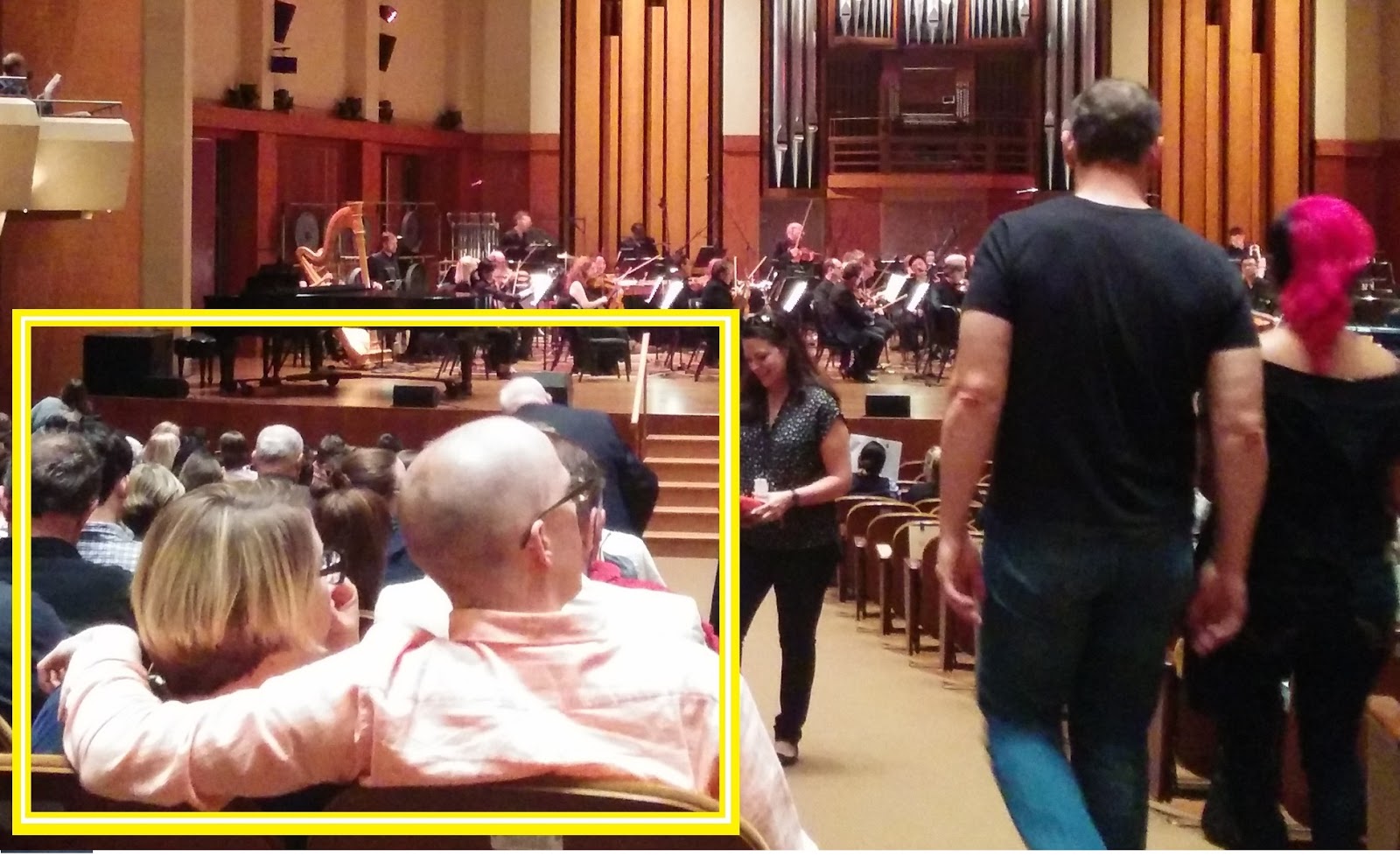
Before the show started, I was trying to snap a picture of the stage...

...because it featured a wall of gongs.  I repeat: An entire wall of gongs.
It's there, partially hiding behind the piano and the harp.
Ready to pounce at any moment.
It was only when I looked at the picture later that I realized it had so many other little gems in it.

Rarely observed in the symphonic wild, behold the blue jeaned - canvas Toms footed - pink mohawked - Hipster sapien:
This appears to be a breeding pair.
And finally, trying desperately to maintain their acoustically-balanced territory on the velvet-upholstered slopes, the clearly-intimidated old couple.
Their stares are unmistakable.
Her hand is delicately raised to her mouth,
stifling a gasp of horror.
His arm is protectively wrapped around her,
ready to defend from the fuscia mohawk onslaught.
Thanks for keeping it reliably interesting, Seattle. I really mean that.
The real question may be which of these symphony couples delights or distresses you more?

Wednesday, May 11, 2016

Frustration and Brilliance and Late-night Infomercials

My last post was about hard questions without good answers.
(Somehow, it turns out it was also about cats wearing space suits.) 
Because really when you come right down to it,
maybe Catstronaut is the answer after all?
While I was thinking about all that, it occurred to me that what controversy and frustration really come from is the mismatch between how bad a problem is (ENORMOUSLY bad) and how adequate the solution is (WOEFULLY inadequate). 

By extension, I wonder how many of the world's issues can be charted out according to how well-matched the problems and solutions are.
Problems can range from being no big deal (toast with the crust still on it) all the way up to indescribably awful (life/death/dismemberment/catastrophe/war).
Solutions can range from being completely useless (battery-powered light-up pepper grinder) to beautifully life-changing (cataract surgery restoring sight to the blind).
When the magnitude of the problem and the solution matches up, you're on the green line here:


If you could boil down the stuff our sincerest most human goals and aspirations are made of;
if you could condense the very essence of what parents want their children to grow up to do,
it would be that we find the perfect solutions for the hardest problems. Cure cancer! Clean up the SuperFund sites! Make Donald Trump's hair look good! Do something worthy of a Nobel Prize! Solve political corruption in Latin America! Build a better mousetrap! Move humanity forward!
It would be where the Green zone sits on this matrix:


Green is what we all dream of accomplishing in our lives: Finding an authentic answer to an enormous and profound problem. It's establishing accessible clean water in developing countries. It's implementing the affordable effective vaccine that eradicated smallpox worldwide. It's the innovatively-engineered retrofits that brought Apollo 13 home.

At the other end of that line where problems and solutions are well-matched, you've got ineffective solutions to problems that aren't really problems. It's the Yellow zone of the graph.


Yellow is a place for all those life hacks on Facebook. They don't actually work but it doesn't matter because the problem wasn't that big of a deal anyway. Solutions...or not... for problems... or not... doesn't really matter, doesn't really stir up a heated debate, doesn't inspire brilliant efforts. Meh?...or not.

But what happens when a brilliant mind pours blood, sweat, tears, time, and mental energy into finding the perfect solution to a tiny problem? A problem that wasn't really worth spending so much brain power on?  That's the Blue zone on the graph:

Blue is late night infomercial products and virtually everything in the now-defunct SkyMall catalogues -- great solutions to problems that never actually bothered you all that much.  Blue is 6 misspent years doing ingenious work to get a hard-earned PhD on a pointless topic, making a substantial contribution to a field no one cares about, then going on to work at Starbucks. Blue is where brilliance is wasted.

What if the effort going toward the Blue zone could be reallocated? What if all that phenomenal cosmic effort were pointed toward phenomenal cosmic problems?
The place where we have staggering, seemingly-insurmountable problems and woefully inadequate solutions is the Red zone on the matrix:


Red is traumatic optic neuropathy and CPR in space and cold fusion and the Syrian refugee crisis and trying to raise good children in a rough world. Crushingly difficult issues with no good answer, no matter how much we wish we had a good answer. It's a churning, struggling, unsatisfying, painful place. The Red zone is full of things worth arguing about and problems worth grappling with.

I'd hazard a guess that everything that has ever arrived to the Green zone was in the Red zone first.
That means that frustration and controversy are only bad things if we sit around angrily-but-ineffectually stewing about them, rather than actively pushing them along the pathway toward the Green zone.

So there it is. Red, Yellow, Green, or Blue.
What are you spending your life on right now?